Picking a camera body feels personal because it locks you into a lens system for years. A wrong call at this stage costs more than the body itself.
The Sony A7 IV vs Canon R6 Mark II debate keeps showing up in forums, gear threads, and Reddit posts for a reason. Both cameras target the same hybrid creator.
But specs alone never tell the full story. Shooting style, lens budget, and how you rig for video all shift the answer in directions that spec sheets ignore.
This comparison is built for the solo hybrid creator running both photo and video jobs on one body without a second shooter to cover gaps.
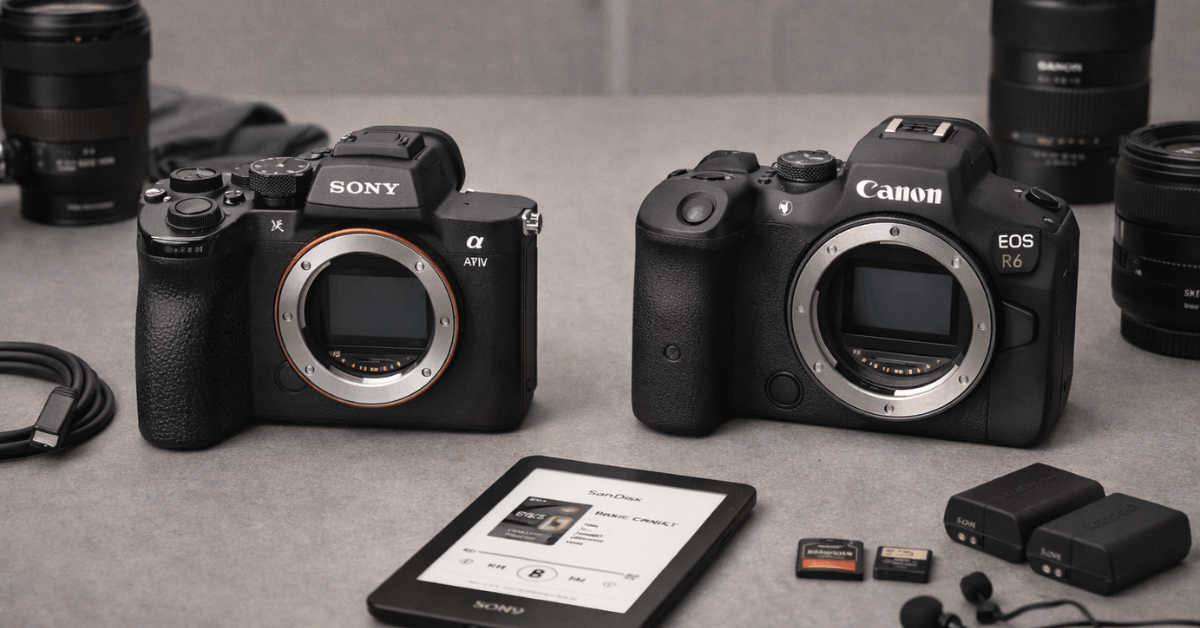
Sony A7 IV vs Canon R6 Mark II Specs Side by Side
Both cameras cover the same core feature set, but their engineering priorities split in ways that matter once you start building a kit around them. The table below strips away marketing language and focuses on the numbers that change how you shoot.
| Feature | Canon R6 Mark II | Sony A7 IV |
|---|---|---|
| Sensor resolution | 24.2 MP full-frame | 33 MP full-frame |
| 4K60 video | Full-width, no crop, 6K oversampled | Super 35 crop only; 4K30 from 7K oversample |
| IBIS | Up to 8 stops (with RF lenses) | Up to 5.5 stops |
| Burst rate | 12 fps mechanical / 40 fps electronic | 10 fps continuous with AF |
| Card slots | Dual UHS-II SD | CFexpress Type A + SD |
| HDMI output | Micro HDMI | Full-size HDMI |
| Video codecs | H.265, Canon Log 3 | XAVC S-I All-Intra up to 600 Mbps, S-Cinetone |
The split is clear: Canon prioritizes speed and ease of use, while Sony loads up on resolution, codec depth, and I/O durability.
Image Quality and Color Science Differences
Resolution and color handling separate these two bodies faster than any other spec, especially for creators who crop aggressively or deliver large prints.
Does 33 MP vs 24.2 MP Matter for Your Work?
Sony’s 33 MP sensor gives noticeably cleaner detail in tight crops and large-format printing. The A7 IV’s dynamic range hits around 15 stops in Sony’s testing, which means a single exposure can hold sky highlights and deep shadows without bracketing.
Canon’s 24.2 MP sensor produces smaller files and keeps noise well controlled at high ISOs. That lower pixel count pairs nicely with fast primes in dim reception halls or concert venues.
Canon Color Science vs Sony Color Profiles
Many portrait photographers still pick Canon for one simple reason: the JPEG color straight out of the body looks great on skin. Quick-turnaround wedding galleries or event coverage where clients expect same-day previews benefit from that Canon color warmth.
Sony’s color has improved substantially over older A7 bodies. S-Cinetone gives video-first shooters a flattering skin tone profile without a full grading pass, which saves hours in post for talking-head and interview content.
Autofocus and Tracking: Canon vs Sony in 2026
Both AF systems feel confident and sticky during action, but they solve tracking problems differently. The difference shows up most when subjects are unpredictable or mixed.
Canon Dual Pixel CMOS AF II Subject Detection
Canon’s system uses deep-learning trained subject detection for people, animals, and vehicles. The menu structure is simple: pick a subject type, and the body handles the rest.
For sports sideline work or pet photography, that simplicity reduces the chance of missing a frame because you were tweaking AF settings.
The R6 Mark II tracks confidently across the sensor area, and switching between subject types takes a few taps. That speed matters during chaotic events where dogs, kids, and adults are all moving through the frame at once.
Sony Real-Time Tracking and Eye AF
Sony’s approach covers dense AF points across the sensor and extends animal eye AF into video recording, not just stills. Bird detection in both stills and movies makes the A7 IV a strong pick for wildlife creators who also shoot video content.
I think Sony’s tracking behavior gives it an edge for mixed-subject video because the system does not require you to pre-select a subject type the way Canon does.
During a multicam interview where the camera might need to grab a product on the table, then snap back to the speaker’s face, that flexibility matters.
Video Features and Codec Options
Video reliability over long shoots separates these two bodies for creators who depend on the camera running for 30, 60, or 90 minutes without overheating or dropping frames.
4K60 Full-Width vs Cropped
Canon’s 4K60 runs at full sensor width with no crop, which keeps focal lengths consistent whether you shoot at 24p, 30p, or 60p. That consistency saves headaches on gimbals and tight interior setups where a crop would push your wide-angle into mid-range territory.
Sony’s 4K60 switches to a Super 35 crop, which changes the effective focal length of every lens you own. The tradeoff is that Sony’s 4K30 mode pulls from a 7K oversample, producing extremely sharp downscaled footage for narrative and documentary work.
Codec Depth and Color Grading Flexibility
Sony packs XAVC S-I All-Intra up to 600 Mbps and 10-bit 4:2:2 recording options. Editors who run heavy color grades or composite work will pull more detail from Sony’s files. Canon records solid 10-bit internally too, but the codec options are less varied.
Canon counters with the ability to output 6K60 RAW over HDMI to external recorders like the Atomos Ninja V+, opening up a high-end finishing path that bypasses internal codec limits entirely.
Also Read: iPhone 15 vs Google Pixel 8: Comparison Guide Focused on Real Benefits
The IBIS Debate: 8 Stops vs 5.5 Stops
I think Canon’s 8-stop IBIS advantage is overstated for video-first creators, because the majority of paid video work happens on tripods, gimbals, or sliders where IBIS is irrelevant.
That 8-stop number shines for handheld photography at slow shutter speeds during travel or interior real estate shoots, but video creators rarely lean on IBIS as their primary stabilization method.
Canon’s stabilization system does pair brilliantly with coordinated RF lenses for run-and-gun documentary and wedding ceremony work. The R6 Mark II also delivers 40 fps electronic burst and 12 fps mechanical, making it a strong pick for dance recitals, wildlife, and sideline sports coverage.
Sony’s 5.5-stop IBIS paired with 10 fps continuous shooting is sufficient for weddings and documentary photography. The lower burst count also keeps file management sane after a long event day.
HDMI, Cards, and Rigging for Paid Video Work
This is the section that almost no comparison article spends enough time on, and it changes the buying decision for anyone building interview rigs or multicam setups.
Full-Size HDMI vs Micro HDMI
Sony’s full-size HDMI port handles repeated cable connections, heavier recorder cables, and crowded cage builds without the fragility risk that micro HDMI introduces. A snapped micro HDMI port during a paid shoot is a nightmare scenario with no quick fix.
Canon ships with micro HDMI, which works fine for occasional external recording but adds stress to any rig that gets broken down and rebuilt weekly. Cable clamps and HDMI protectors help, but they add bulk and cost to your cage setup. The Sony A7 IV product page lists the full I/O specifications for rig planning.
CFexpress Type A vs Dual SD
Sony’s CFexpress Type A slot in position one supports the higher bitrate All-Intra codecs and provides faster write speeds for burst photography. The second slot takes standard UHS-II SD cards, so you can use affordable media for overflow or backup.
Canon’s dual UHS-II SD setup keeps media costs low and universal. SD cards are available everywhere, and dual identical slots simplify backup workflows. For photographers who do not shoot high-bitrate video, Canon’s card setup is more practical and cheaper to maintain.
Lens Ecosystem and Long-Term Cost
Budget planning shifts dramatically once lenses enter the equation, and this is where the Sony vs Canon conversation gets real.
The RF mount lens catalog includes exceptional L-series glass, but pricing runs high. Third-party autofocus lens options for full-frame RF remain limited in 2026, despite recent APS-C RF releases from Sigma. That means Canon shooters pay Canon prices for most of their glass.
Sony’s E-mount has a deep third-party catalog from Sigma and Tamron at competitive prices. A solo creator building a three-lens kit on E-mount can save $1,000 to $2,000 compared to an equivalent RF mount setup, according to current retail pricing on B&H Photo.
That lens cost gap is the single biggest long-term financial factor in this decision, and it rarely gets the attention it deserves in comparison articles.
Which Camera Fits Which Shooting Style
Specific use cases help cut through the noise:
- Sports, wildlife, and fast events: The R6 Mark II’s 40 fps electronic burst, coordinated 8-stop IBIS, and simple subject detection menus give it an edge for speed-dependent work
- Interviews, courses, and long-form video: The A7 IV’s 600 Mbps All-Intra codec, S-Cinetone profile, reliable thermal behavior, and full-size HDMI make rigging and post-production smoother
- Portraits and weddings: Canon’s color science delivers quick-turnaround galleries; Sony’s 33 MP sensor supports aggressive cropping for album design
- Budget-conscious solo creators building a kit: Sony’s third-party lens depth and CFexpress upgrade path keep total system cost lower as projects scale
Questions People Ask About Sony A7 IV vs Canon R6 Mark II
Q: Can the Sony A7 IV shoot 4K60 without any crop? No. The A7 IV crops to Super 35 at 4K60. Only 4K30 uses the full sensor width with 7K oversampling. This matters for wide-angle shooters who lose field of view at higher frame rates.
Q: Is the Canon R6 Mark II better for low-light photography? The R6 Mark II’s 24.2 MP sensor produces less noise at high ISOs compared to the A7 IV’s denser 33 MP chip. Paired with fast RF primes and 8-stop IBIS, it handles dim environments well for handheld stills.
Q: Do third-party lenses work on the Canon RF mount? Full-frame autofocus options from Sigma and Tamron remain limited for RF mount in 2026. APS-C RF lenses have started arriving, but the full-frame third-party selection trails far behind Sony E-mount.
Q: Which camera overheats less during long video recordings? The A7 IV has a solid reputation for thermal management during extended recordings. The R6 Mark II handles typical session lengths without issue, though shooters running 4K60 continuously should test heat limits under their specific conditions.
Q: Is the Sony A7 IV still worth buying in 2026? The A7 IV remains a competitive hybrid body in 2026 because of its 33 MP sensor, 10-bit codec options, and E-mount lens ecosystem. Sony has not replaced it yet, and firmware updates have refined its AF performance since launch.
Conclusion
The Sony A7 IV and Canon R6 Mark II both anchor professional hybrid workflows without compromise. Canon rewards creators who need speed, color accuracy, and simple AF subject menus out of the box.
Sony pulls ahead for codec-heavy video work, rig durability, and long-term lens savings through E-mount. The right body depends on which side of the photo-video split carries your income.