
Staring at two browser tabs. One open to AirPods Pro 2, the other to Sony WF-1000XM5. The spec sheets blur together after a while.
Every comparison article tells the same story: Sony wins on battery, Apple wins on ecosystem. That framing misses what matters during a 40-minute commute or a 3-hour work block.
The AirPods Pro 2 vs Sony WF-1000XM5 debate has a hidden deciding factor that rarely gets top billing. And it lives in the midrange frequencies, right where vocals and instruments sit.
This breakdown is for the iPhone user who suspects Apple is the safe pick but keeps hearing that Sony sounds better. Let’s sort that out.
AirPods Pro 2 vs Sony WF-1000XM5 Specs Side by Side
Spec sheets can end a decision quickly when one pair clearly outclasses the other. These two trade punches across different categories, though, so the table below frames where each pair lands on the things that affect daily use.
| Feature | AirPods Pro 2 | Sony WF-1000XM5 |
|---|---|---|
| ANC System | H2 chip, Adaptive Audio, Conversation Awareness | Dual-processor ANC, strong passive isolation |
| Battery (buds / total) | ~6 hrs / ~30 hrs with case | ~8 hrs / ~24 hrs with case |
| Bluetooth Codecs | AAC only (lossless via Apple Vision Pro) | SBC, AAC, LDAC, LC3 (LE Audio) |
| Water/Dust Rating | IP54 (buds and case) | IPX4 (buds only) |
| Multipoint | No (iCloud device switching instead) | Yes |
| Tip Material | Silicone (multiple sizes) | Memory foam (default) |
The takeaway: AirPods Pro 2 lead on durability rating and total case battery, while Sony edges ahead on codec variety and single-charge stamina.
How Do AirPods Pro 2 and Sony WF-1000XM5 Sound Different?
Sound tuning differences between these two pairs are subtle in a 30-second store demo. They become obvious after a few hours of real listening. Both aim for a mainstream, crowd-pleasing balance, but they get there through different priorities.
Bass Response on AirPods Pro 2 vs Sony WF-1000XM5
Both models deliver clean sub-bass in pop, hip-hop, and electronic tracks without drowning the rest of the mix. The difference is how they handle the handoff between low end and mids.
AirPods Pro 2 keep bass punch tight. Vocals breathe clearly even at commuter volumes, which makes a real difference on podcasts and vocal-heavy playlists.
Sony WF-1000XM5 add more low-end weight, creating a warmer balance that pairs well with bright streaming masters. Sony’s app includes EQ tools that can tighten the curve if the factory setting feels too plush.
Midrange Clarity: The Part That Decides Daily Satisfaction
I think the midrange difference between these two earbuds matters more than ANC or battery life for the average iPhone user, because midrange frequencies carry vocals, acoustic instruments, and podcasts: the content that fills 80% of a typical listening day.
AirPods Pro 2 push mids forward. Vocals sit correctly in the mix. Acoustic tracks and brass instruments land where they should, and the effect is consistent across volume levels.
Sony WF-1000XM5 dip slightly through the mids in stock tuning. Singers sound a small step farther away compared to Apple’s presentation.
This difference shows up clearly in indie and acoustic genres where intimacy matters. Does that make Sony bad? No. But it is a tradeoff that matters if spoken word and vocal music dominate the rotation.
Treble Behavior
Treble stays restrained on both, which avoids glare and sibilance in harsh recordings. AirPods add a controlled sparkle that helps solo instruments cut through dense arrangements.
Sony keeps things smooth and avoids any shout, which pairs especially well with LDAC playback on Android when the source material has richer top-end detail.
Also Read: Detailed Comparison Based on Real Use
Noise Cancelling and Transparency Mode Comparison
Both pairs silence low-frequency rumble on planes and buses. The separation happens in how each one handles mixed environments.
AirPods Pro 2 Adaptive Audio and Conversation Awareness
AirPods Pro 2 layer Adaptive Audio and Conversation Awareness on top of standard ANC and Transparency.
The system automatically drops volume and opens mics when it detects nearby voices. For office workers who constantly pull earbuds out to talk, this feature eliminates a dozen daily interruptions.
Sony WF-1000XM5 ANC and Ambient Sound
Sony’s dual-processor ANC paired with memory-foam tips delivers raw isolation that slightly edges ahead of AirPods in pure noise-blocking.
Ambient Sound modes stay flexible for walking and office environments. The tradeoff is manual: switching between modes requires a tap or an app toggle rather than the automatic awareness Apple offers.
Battery Life: Why Single-Charge Hours Are Overrated
This is where I disagree with how every comparison frames the battery conversation. The standard line goes: Sony WF-1000XM5 gets about 8 hours per charge versus 6 hours for AirPods Pro 2, so Sony wins on battery. That framing ignores how people use earbuds.
Almost nobody wears earbuds for 8 straight hours. The real pattern looks like this: listen for 45 minutes, drop them in the case for a meeting, pick them back up for an hour, case again during lunch. That pattern makes total case battery the number that matters.
AirPods Pro 2 deliver roughly 30 hours total with the USB-C case. Sony WF-1000XM5 land around 24 hours total. That is a 6-hour gap in Apple’s favor when measured by how earbuds are used outside of a lab test. Both support wireless charging and fast top-ups, so neither pair will die on a normal day.
The 8-hour Sony figure matters only if continuous, unbroken playback is the routine. Long-haul flights qualify. Daily commutes and desk work do not.
Codecs and Connectivity: Does LDAC Matter on iPhone?
Codec support shapes whether fancy Bluetooth audio specs translate to real-world quality on a specific phone. The answer depends entirely on the device in the pocket.
Sony WF-1000XM5 LDAC and Multipoint
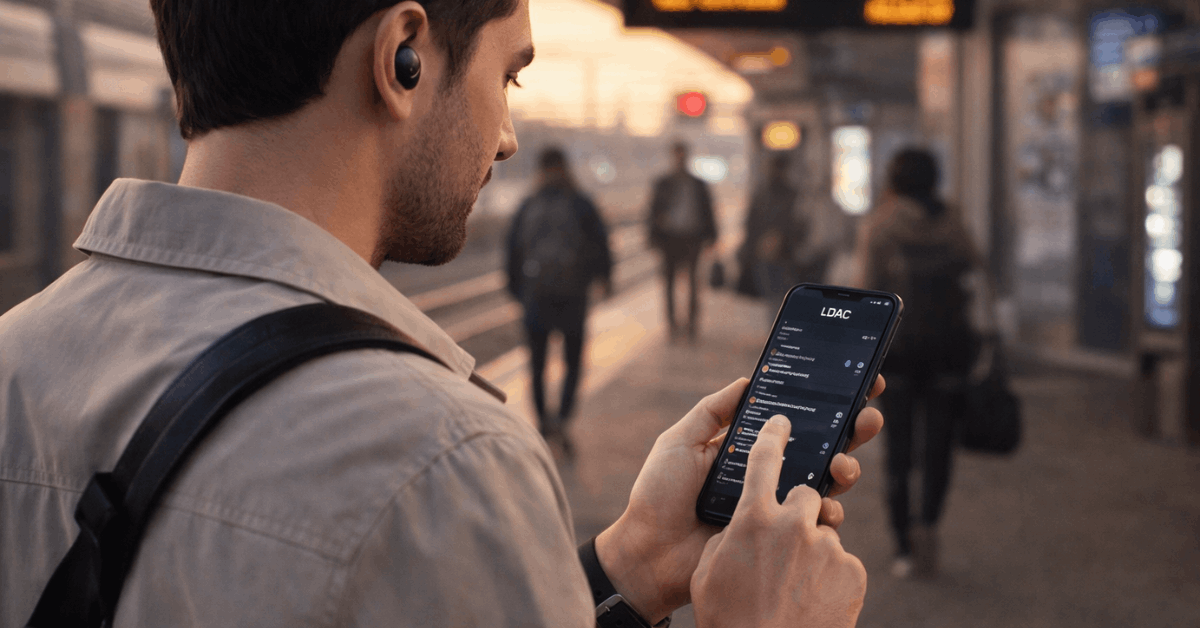
Sony supports LDAC, which enables higher-bitrate Bluetooth streaming on compatible Android devices. LC3 codec arrives where LE Audio is enabled, future-proofing the connection. Multipoint connectivity lets two devices stay paired at once, which is useful for laptop-to-phone switching during work.
All of that disappears on iPhone. Apple does not support LDAC. An iPhone user buying Sony WF-1000XM5 gets AAC Bluetooth, the same codec AirPods use, but without the ecosystem tricks that make AirPods feel invisible.
AirPods Pro 2 on iPhone vs Sony WF-1000XM5 on iPhone
AirPods Pro 2 use AAC over Bluetooth and skip LDAC entirely. On paper, that sounds limiting. On iPhone, it does not matter because iOS caps Bluetooth audio at AAC regardless of what the earbuds support.
The real advantage is the ecosystem layer: iCloud device switching, automatic pairing, Find My case tracking, and Spatial Audio for Apple Music Dolby Atmos content.
Sony WF-1000XM5 paired with an iPhone work as basic Bluetooth earbuds. Spatial personalization, automatic switching, and deep OS integration are all absent.
An Android user should weigh Sony’s codec advantages seriously. An iPhone user does not get to use them. That single fact reshapes the entire comparison. Apple AirPods Pro 2 specs confirm the AAC-only Bluetooth connection that makes LDAC irrelevant on iOS.
Comfort and Fit During Long Listening Sessions
AirPods Pro 2 Silicone Tips and Pressure Relief
AirPods Pro 2 use soft silicone tips across multiple sizes with a low-nozzle angle. The design includes in-ear pressure relief, which reduces that plugged-up feeling during extended wear. Stem controls add a precise volume swipe that becomes second nature within a week.
Sony WF-1000XM5 Memory Foam Tips
Sony’s default memory-foam tips create a strong seal and stabilize the buds well.
Some listeners feel gradual pressure buildup during sessions past 90 minutes, which has pushed certain owners toward third-party silicone replacements. Touch controls on the Sony are responsive, though they lack the granular volume swipe that Apple’s stem design offers.
A common mistake: buying earbuds based on store demos that last five minutes. Fit comfort changes dramatically between minute five and minute ninety.
Calls and Mic Quality on Both Earbuds
Office call blocks and windy sidewalks are where mic quality separates good from frustrating. AirPods Pro 2 present voices clearly in mixed environments thanks to consistent beamforming that favors speech.
Sony WF-1000XM5 handle indoor calls well and suppress rumble outdoors, though the deep insertion of foam tips can slightly color how the wearer hears their own voice.
Both deliver clean results for everyday video meetings when tip fit is dialed properly. The AirPods pull ahead in noisy, unpredictable spaces.
Alternatives Worth Checking
The earbuds worth a look if neither Apple nor Sony feels right:
- Galaxy Buds3 Pro: lively tuning and deep Android integration for Samsung users
- Sennheiser Momentum True Wireless 4: energetic bass and detailed highs with deep app control
- Bowers & Wilkins Pi8: premium build and refined sound for buyers leaning upscale
Start the shortlist with ecosystem fit, then move to sound profile and tip comfort. Sony WF-1000XM5 official page has full firmware update logs and tip compatibility details.
Questions People Ask About AirPods Pro 2 vs Sony WF-1000XM5
Q: Are Sony WF-1000XM5 worth buying for iPhone users? They work fine over AAC Bluetooth, but LDAC and multipoint advantages disappear on iOS. The Sony app still provides EQ control, though automatic switching and Find My integration are absent. An iPhone user pays full price for about 60% of the Sony feature set.
Q: Do AirPods Pro 2 sound better than Sony WF-1000XM5? “Better” depends on preference. AirPods push vocals and mids forward, which suits speech-heavy content and acoustic music. Sony leans warmer with more bass weight. Neither is objectively superior, but the midrange difference is noticeable within minutes of switching between them.
Q: Can I use AirPods Pro 2 with Android? They pair over standard Bluetooth and handle calls and media. Spatial Audio personalization, Conversation Awareness, and automatic device switching do not work on Android. The experience is bare-bones compared to pairing with an iPhone.
Q: How long do AirPods Pro 2 last compared to Sony WF-1000XM5? AirPods get about 6 hours per charge with roughly 30 hours total from the case. Sony gets about 8 hours per charge with roughly 24 hours total. For listeners who frequently dock earbuds between sessions, AirPods’ larger case reserve matters more than Sony’s longer single-charge time.
Q: Which earbuds have better noise cancelling in 2026? Both rank at the top of the wireless earbud ANC tier. Sony’s foam tips add passive isolation that edges ahead in raw noise blocking. AirPods counter with Adaptive Audio that adjusts ANC and transparency automatically based on the environment, which is more practical for mixed daily use.
Conclusion
The AirPods Pro 2 vs Sony WF-1000XM5 decision comes down to ecosystem and midrange priorities. iPhone users gain the most from AirPods Pro 2 because Sony’s codec advantages vanish on iOS.
Android owners should test Sony’s LDAC streaming and EQ depth before committing to either pair. Pick whichever midrange presentation makes vocals sound right to your ears.