Somewhere between your morning alarm and midnight, one of these watches will be dead on a charger. That single fact changes everything about the Apple Watch Series 9 vs Garmin Venu 3 decision.
Every comparison article lines up specs in neat rows. But the spec that matters sits on your nightstand: your charging cable.
The Apple Watch Series 9 vs Garmin Venu 3 debate splits along a line that has nothing to do with screen brightness or case material. It splits along how you sleep.
And if sleep tracking sounds like a minor feature to you, I’d argue it’s the one that should drive this entire purchase.
How the Apple Watch Series 9 and Garmin Venu 3 Compare on Paper
Raw specifications tell a partial story, but they do set the floor for what each watch can handle across a normal week. Both watches target the same buyer: someone who works out, commutes, and wants health data without wearing a brick.
Apple Watch Series 9 vs Garmin Venu 3 Specs Side by Side
| Feature | Apple Watch Series 9 | Garmin Venu 3 |
|---|---|---|
| Sizes | 41 mm, 45 mm | 41 mm (3S), 45 mm |
| Display | Always-On LTPO OLED, up to 2,000 nits | AMOLED, always-on option |
| Battery Life | Up to 18 hours typical | Up to 14 days (10 days on 3S) |
| Water Rating | WR50 (swim-ready) | 5 ATM (swim-ready) |
| Cellular Option | GPS or GPS + Cellular | GPS only |
| Starting Price (USD) | ~$399 aluminum | ~$449 |
The takeaway: Apple wins on display brightness and cellular freedom, while Garmin wins on battery life by such a massive margin that the two watches live in different charging universes.
Case Materials and Weight
Apple sells aluminum and stainless-steel cases. The aluminum Series 9 starts at 31.9 grams for the 41 mm and 38.7 grams for the 45 mm. Garmin pairs a stainless steel bezel with a fiber-reinforced polymer body that drops the Venu 3 to roughly 27–30 grams without the band.
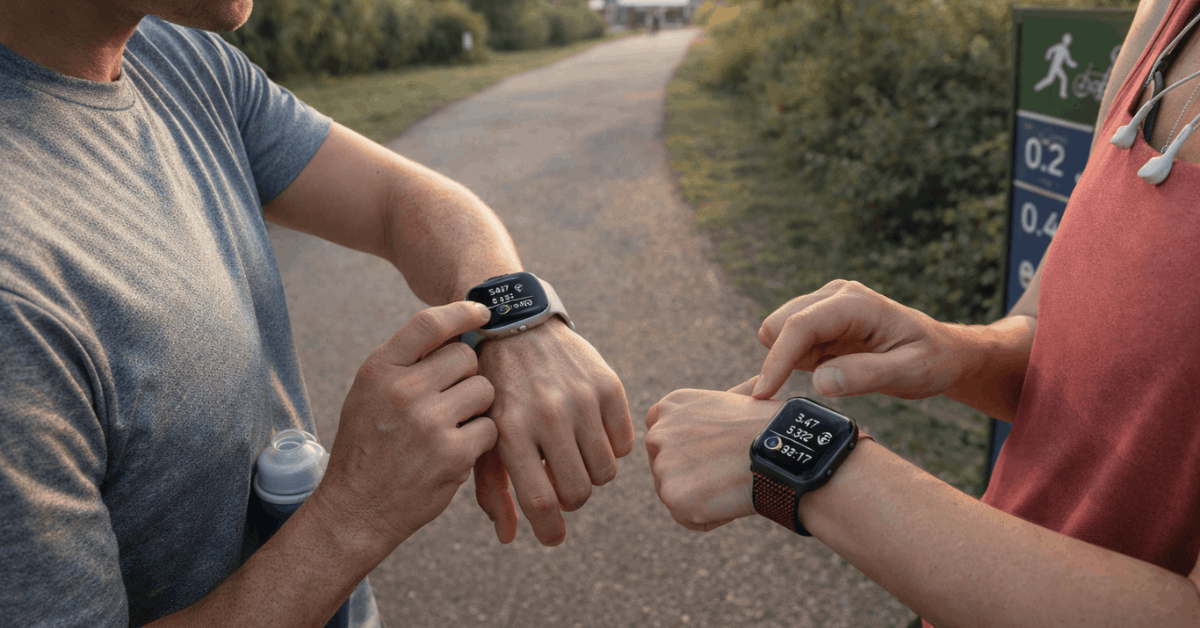
That weight difference sounds trivial until you sleep in the watch for five consecutive nights. Lighter matters when the watch never leaves your wrist.
Buttons, Crowns, and Sweaty Fingers
Series 9 uses the Digital Crown and a side button. The crown is satisfying to scroll, and Apple’s haptic feedback makes it feel precise even during a run.
Garmin uses three physical buttons paired with touch, which keeps workout controls responsive when your fingers are wet or covered in chalk. Neither approach is bad. The question is whether you interact with your watch mid-workout or mostly check it after.
Battery Life: The Feature That Decides Everything Else
This is the section that should sit at the top of every Apple Watch Series 9 vs Garmin Venu 3 article, and it almost never does. Battery life isn’t a spec. It’s a lifestyle constraint that shapes every other feature you can use.
Apple Watch Series 9 Battery Life in Real Days
Apple quotes up to 18 hours under a mixed-use profile. That means charging every single night. Fast charging gets the Series 9 to roughly 80% in about 45 minutes using the USB-C magnetic puck, so a quick top-up during a shower is realistic.
But here’s what 18 hours forces on you: a choice between sleep tracking and a full charge for tomorrow.
Plenty of Apple Watch owners charge at night and skip sleep data entirely. That trade-off gets buried in reviews, but it shapes the health story this watch can tell you over weeks and months.
Also Read: Kindle Paperwhite vs Kobo Clara 2E: Product Comparison Based on Practical Use
Garmin Venu 3 Battery Life in Real Days
Garmin quotes up to 14 days on the larger model and up to 10 days on the 3S. Real-world use with workouts, notifications, and the always-on display lands most people between 4 and 8 days. Full charge time runs about an hour.
I think the Garmin Venu 3’s 4-to-8-day real-world battery makes it a better health tracker than the Apple Watch Series 9, specifically because it can collect continuous sleep data without forcing a nightly charging decision.
That’s a contrarian take, since Apple’s sensor hardware is arguably more advanced. But the best sensor in the world produces zero data when it’s sitting on a charger at 2 AM.
Smart Features and Daily App Life
The software story separates these watches cleanly. One runs a full app ecosystem tied to the world’s largest phone platform. The other runs a focused health dashboard that does fewer things with less friction.
watchOS on Series 9
Series 9 runs watchOS with an app catalog that covers banking, messaging, ride-hailing, podcasts, and more.
The Double Tap gesture lets you answer calls, control media, and scroll Smart Stack cards with one hand. It works after a wrist raise, so it’s not fully passive, but it’s useful when your hands are full of grocery bags or a toddler.
Dictation on Apple Watch is the best on any smartwatch right now. Quick replies to texts land accurately, and Siri handles timers and reminders fast enough that the watch replaces your phone for short interactions.
Garmin’s Health-First Software
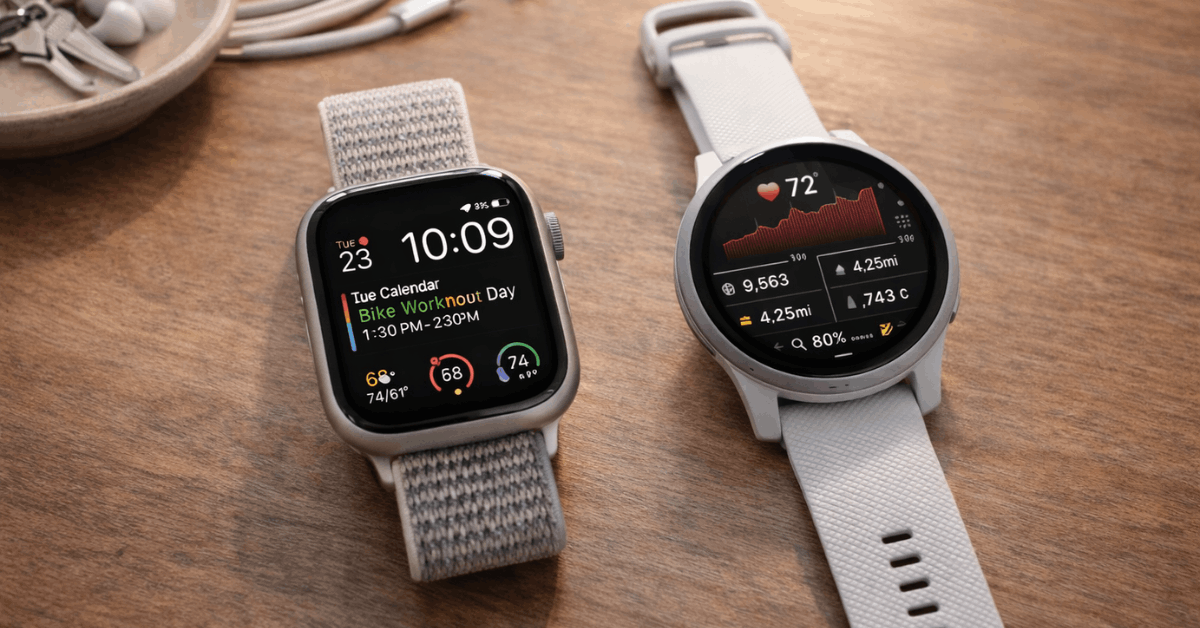
Garmin’s system is built around health dashboards, workout logging, and recovery scores. The Venu 3 added on-wrist phone calls through a speaker and microphone, plus voice assistant relay to your phone. The menus are simpler and the learning curve is shorter.
The trade-off is clear: want to hail an Uber from your wrist? Apple. Want a Sleep Coach that tells you when to go to bed based on last night’s HRV data? Garmin.
Smart features worth comparing at a glance:
- Payments: Apple Pay on Series 9, Garmin Pay on Venu 3. Both work at tap-to-pay terminals, but Apple Pay has wider merchant acceptance globally.
- Phone calls: Both handle calls when your phone is nearby via Bluetooth. Series 9 can take calls independently on the cellular model.
- Notifications: Apple mirrors iPhone notifications with full reply options. Garmin mirrors notifications but with limited reply capability on Android and none on iOS.
Health Sensors and Tracking Accuracy
Heart rate tracking is strong on both during steady-state cardio and daily wear. The differences show up in what each watch does with that data and which extra sensors come along for the ride.
ECG and Blood Oxygen
Apple has shipped an FDA-cleared ECG app for atrial fibrillation detection since the Series 4. The Venu 3 has its own ECG app rolling out regionally on compatible models.
Both watches offer SpO2 readings and wrist temperature monitoring. Apple’s blood oxygen feature returned in the U.S. during 2025 after a redesigned implementation following a legal dispute. Regional availability varies, so checking Apple’s feature availability page for your country is worth the 30 seconds.
Sleep Tracking That Depends on Your Charger
Series 9 estimates sleep stages and feeds data into Apple Health. The data is accurate in aggregate. Garmin’s sleep tracking includes a Sleep Score, trend lines, nap detection, and a Sleep Coach that translates your night into a next-day readiness score.
Both systems need about a week of consistent wear to stabilize their algorithms. And that word “consistent” is the catch. Apple Watch owners who charge overnight have gaps in their sleep data. Garmin owners wearing the Venu 3 for five or six nights straight get an unbroken picture.
GPS for City Runs and Park Loops
Both watches use single-band L1 GPS. For suburban runs and park loops, accuracy is solid on both. Dense urban corridors with tall buildings will challenge any L1-only watch.
Neither the Series 9 nor the Venu 3 has multi-band GPS, which is reserved for Garmin’s higher-end outdoor models and the Apple Watch Ultra line.
Lock a GPS signal before starting your run. That single step eliminates most of the distance drift complaints people post online.
Bands, Comfort, and Living With the Watch
The band situation is a small detail that has a surprisingly big effect on daily comfort, especially during workouts and sleep.
Apple uses a proprietary slide-in band system with a massive catalog of first-party and third-party options. Swapping takes seconds. Garmin uses standard 22 mm spring bars on the Venu 3 (18 mm on the 3S), which means affordable third-party bands are everywhere.
Apple’s system is faster to swap. Garmin’s system is cheaper to accessorize. Pick your priority.
Common mistakes to watch for when choosing bands:
- Silicone bands trap sweat during sleep. Switch to a breathable fabric or nylon band if you plan to sleep in the watch.
- Buying the wrong size case and assuming a band swap will fix comfort. The 41 mm models sit better on wrists under 160 mm circumference.
- Ignoring band width on Garmin. The Venu 3S uses 18 mm bands, not 22 mm. They’re not interchangeable with the standard Venu 3.
Who Should Pick Which Watch in 2026
Pairing decisions come down to three honest questions: how deep are you in the iPhone ecosystem, how often are you willing to charge, and do you care about sleep data continuity?
Series 9 fits best if notifications, dictation, app variety, and Apple Pay drive your daily routine. The cellular model adds independence from your phone during runs or errands.
Garmin Venu 3 fits best if workout coaching, multi-day battery, and unbroken sleep tracking matter more than answering Slack messages from your wrist.
One thing both watches handle well: pool swimming at rated depths, wrist-based heart rate during cardio, and basic contactless payments. The daily experience diverges on everything else.
Check Garmin’s Venu 3 page for the latest firmware updates and regional feature rollouts, since Garmin has been adding features through software updates on a steady cadence through 2025 and into 2026.
Questions People Ask About Apple Watch Series 9 vs Garmin Venu 3
Q: Can the Garmin Venu 3 work with an iPhone? The Venu 3 pairs with iPhones through the Garmin Connect app. Notifications mirror correctly, but quick replies to messages are only available on Android. If replying from your wrist matters, the Apple Watch is the only real option on iOS.
Q: Does the Apple Watch Series 9 track sleep well enough to compete with Garmin? The sleep stage data is accurate when you wear it. The problem is wearing it. An 18-hour battery means most owners charge overnight, which creates gaps. Garmin’s multi-day battery lets sleep tracking run uninterrupted for days at a time.
Q: Is the Garmin Venu 3 good for gym workouts? The Venu 3 has animated workout guides on-screen and covers strength, HIIT, yoga, and Pilates with rep counting. Garmin’s coaching prompts during a session feel more structured than Apple’s Workout app, which leans on third-party apps like Strong or Fitbod for detailed strength tracking.
Q: Are Apple Watch Series 9 prices dropping in 2026? The aluminum Series 9 started at $399 at launch. Seasonal sales and carrier promotions have pulled it below $350 at various points. Checking retailers during holiday sales or carrier trade-in events typically offers the best pricing on this model.
Q: Can either watch work without a phone nearby? The Apple Watch Series 9 with cellular can make calls, send messages, and stream music independently when paired to a carrier plan. The Garmin Venu 3 requires a Bluetooth connection to your phone for calls and message notifications.
Conclusion
The Apple Watch Series 9 remains the strongest smartwatch for deep iPhone integration and daily app use. Garmin Venu 3 earns its price through battery stamina and sleep tracking consistency that Apple cannot match.
Choosing between them is a question about your nightstand, not your wrist. The watch that stays on you longest tells you the most about your health.